Showing posts with label Gamuda MMC. Show all posts

Tuesday, June 25, 2013

KVMRT underground engineers

The world’s first variable density tunnel boring machine (TBM) is running silently beneath Kuala Lumpur’s streets, ready to lay off the 9.3km-long tunnel for Klang Valley Mass Rapid Transit.

All ready to do Malaysia proud, but more importantly, this is the beginning of the creation of a pool of talent conversant in underground work, especially in bored tunneling. This is MMC-Gamuda’s underground team inside the Cochrane launch shaft, where four TBMs will eventually be launched.

To handle the tunneling project of the Line 1, MMC-Gamuda take on approx. 500 engineers and technicians, which comprised a large pool of Malaysians.

Quick facts:
10 TBMs will be used to complete one pair of 9.3km-long tunnels. These TBMs were custom-made by German and Chinese contractors, and could be reused for subsequent lines.

The first (and last) rail tunnel done using TBMs was in the 1990s, when a pair of 5km tunnels was excavated for the Putra line (now called Kelana Jaya line) to serve five underground stations (Masjid Jamek-Dang Wangi-Kampung Baru-KLCC-Ampang Park).

Among them are:

Freshies like Lim Hui Yan, a Universiti Putra Malaysia graduate in mechanical engineering, are instrumental in overseeing the introduction of a new method of concrete segment fabrication.

“I am indeed lucky to be posted here as tunnel engineer, as tunnelling works rarely involve female engineers. And I discovered that mechanical works play a big part in the success of tunnelling,” said the Johorean, 23.

Fellow female tunnel engineer Mandy Ang Yian Yong, 26, is entrusted with the full gamut of construction tasks ranging from tendering and design to procurement and construction. “I am very grateful for this opportunity. Being a tunnel engineer for almost three years now, I have gained vast technical knowledge and planning strategies,” said the Sarawakian.

Personnel:
Ng Hau Wei MMC-Gamuda KVMRT’s senior construction manager
Lim Hui Yan
Mandy Ang Yian Yong
Female tunnel engineer
Mazuki Mohamad Salleh tunnel manager based at the Cochrane launch shaft
Ruslan Mohamed TBM electrical superintendent
Azlan Marzuki Shah Julaihi tunnel engineer

Sunday, May 19, 2013

KVMRT Line 2

Klang Valley Mass Rapid Transit Line 2 will be even bigger than the first line. The new line is longer than the predecessor, it will have a longer underground section and more stations. That means it will cost more too.


Initial estimates peg the cost of Line 2 at RM24.9bil once the line is extended from Serdang to Putrajaya. Construction of the proposed second line will be done in two stages with the first stage up to Serdang. The cost of that will be similar to that of the first line.

The main difference between the first and second line though will be ridership.


Estimates show that 20% more people, or 550,000 passengers a day, will traverse through line 2 as opposed to 460,000 a day for Line 1.

In terms of passengers per km, Line 2 is expected to ferry 11,100 passengers per km compared with 10,000 passengers per km for Line 1.

Projections also show that Line 2 will carry 40% more people than Line 3, or the circle line, upon completion.

The reason for the higher ridership is that Line 2 will cut through more densely populated and lower income areas. Neighbourhoods such as Damansara Damai, Kepong, Batu Kampung Pandan, Kampung Baru, Sentul and Serdang are large catchment areas of people.

The alignment of Line 2 will also cut near to areas where PR1MA is expected to build affordable housing for Malaysians. Areas such as Sungai Buloh, Kentonmen and Serdang where PR1MA is expected to build mass affordable housing

Both Line 1 and 2 are expected to converge at the Tun Razak Exchange which will enable passengers to interchange onto other lines. [KVMRT: For the whole 51km MRT Line, the only interchange station is at Tun Razak Exchange, how is it possible for passengers flow? Assuming 10% of Line 1 disembark and 20% of Line 2 interchange, it will see about 46,000 and 110,000 passengers at one particular station.]

Line 2 will also serve the KLCC area as it will cut through the middle of the city centre as opposed to the Light Rail Transit line that serves the northern part of the development.


A decision to proceed with Line 2, which is a radial line instead of the circle comes down to catchment and ridership.

Normally, like in the case of Singapore, the circle line will come last. They will do the radial lines first. It's because the radial lines will help you build up the catchment and ridership. The circle line just connects the lines for you. The priority is to first build the network and its catchment.

Ringgit and sen wise, Gamuda points to the study by Halcrow on the economic internal rate of return (EIRR). It claims that the consultant had put an EIRR at 27% which captures the social benefits of the project, value of time and the multiplier impact of the MRT project.

Article read: Will MRT Line 2 go on as planned? (The Star)

KVMRT network structure
According to the the National Land Public Transport Masterplan (final draft), the KVMRT Line 2 or the North-South Line is meant to link developing areas such as Sungai Buloh, Kepong and Selayang with the eastern side of the city centre including Kampung Baru and Tun Razak Exchange.

The third line or the circle line should provide an orbital link between areas such as Mid Valley, Mont Kiara, Sentul Timur, Ampang as well as the planned Matrade.

The KVMRT project, consisting of three lines, is expected to have a total network of 145 km.

By the time the KVMRT Line 1 is completed in 2017, it is expected to carry some 384,000 passengers daily.

A MRT rail system would require some 20,000 passengers per hour per direction to be feasible.


[KVMRT: Technically, one should never define a MRT system as 20,000 pphpd. It is not widely accepted in international standard.]

Wednesday, March 21, 2012

MMC-Gamuda wins MRT tunnelling job

Yesterday, MRT Corp announced the award of the underground package of the MY Rapid Transit (MRT) Sungai Buloh-Kajang line to a joint venture comprising MMC Corporation Bhd and Gamuda Bhd (MMC-Gamuda JV).

Logo of MMC-Gamuda

The decision comes after One Stop Procurement Committee (OSPC) meeting chaired by the Prime Minister, YAB Datuk Seri Mohd Najib Razak at Parliament.

It is known that MMC Gamuda bid price of RM8.2 billion to design and build the 9 5km MRT underground tunnel and seven underground stations, was 3.4 per cent lower than the second lowest offer.

MMC-Gamuda Joint Venture was one of five companies or joint ventures which pre-qualified under a stringent set of criteria to tender the underground package of the MRT project. The other tenderers were Hyundai-Gadang-Chengal Jaya Joint Venture, Taisei Corp, Sinohydro Group Ltd, and the China Railway Group Ltd.

Sunday, October 23, 2011

Pre-qualified bidders for MRT tunnelling project

KVMRT has get the news on the pre-qualified bidders for MRT tunnelling project. Only one Malaysian company, Gamuda-MMC is in the run with five other foreign bidders.

Gamuda-MMC faces lower bids from pre-qualified bidders for MRT tunnelling project (The Star)

PETALING JAYA: The front runner for the mass rapid transit (MRT) tunnelling project – the Gamuda Bhd-MMC Corp Bhd joint venture – may be put in a tough spot to match the lower bids from some of the pre-qualified bidders, industry sources said.

Yesterday a financial newspaper reported that five companies had been pre-qualified for the project, including Gamuda-MMC, China’s Sinohydro Group Ltd, South Korea’s SK Holdings and two other parties from China and Japan.

Gamuda-MMC was the only local company shortlisted.

Reliable sources have confirmed this.

In an e-mail reply to StarBizWeek, Gamuda said: “We have not been informed of being shortlisted.” It didn’t reply to other questions in the e-mail.

The tunnelling works for the MRT is estimated to cost RM7bil and the financial newspaper reported that the pre-qualified parties had three months to submit their bids.

It had been reported that the project delivery partner (PDP) of the MRT project, Gamuda-MMC, would have the upper hand in bidding for the job as it was given the right to match the lowest offer from other bidders for the tunnelling job under the Swiss challenge system (Gamuda-MMC has to match the lowest bid to win).

However, bidders from China are said to pose a threat to Gamuda-MMC due to their expertise and experience in tunnelling jobs as well as having the financial muscles to undertake the project.

A reliable source added that local parties have a price advantage of between 3.5% to 7.5%, depending on the level of local and bumiputra equity participation in the project.

“However even with this price advantage, Gamuda-MMC could still be hard-pressed to match the pricing of some of the other bidders,” an industry source said.

Meanwhile OSK Research pointed out that while there was a risk of the other four pre-qualified names “under-cutting in their bids, we believe the local JV (Gamuda-MMC) still has an edge.”

“As the MRT is funded by the Government, we believe it would like to keep the job largely in the hands of local contractors.

“Furthermore Pemandu (Performance Management and Delivery Unit) had also previously stated that under the Economic Transformation Programme, the awarding of contracts to foreigners would also depend on whether these would have a positive impact on the GNI (gross national income).”

OSK expected Gamuda-MMC to be prequalified for the project, “given Gamuda’s experience with the Penchala Tunnel, Smart Tunnel and Kaohsiung MRT.”

The research house said it expected the award to be made by the end of the first quarter of next year.

What is the criteria?
That maybe the most important question. To who government will awards the project package? The Malaysian government in awarding the jobs will have to weigh whether to go for the cheapest bid or for a higher one by a local player.

“There is no right or wrong, it’s just a matter of priorities,” the industry player said.

Global practices
“In most countries there are mechanisms to prevent foreign bidders from winning jobs, or even bidding. But don’t look at Hong Kong and Singapore, they have different economic models,” an industry player said. The barrier to entry for foreign companies can take many forms, from simple methods such as work permits or visas to more complex mechanisms.

In the European Union (EU) for instance, only EU-based companies are allowed to participate in EU Cohesion Fund projects.

It is the same for Japan International Cooperation Agency (JICA) loans, where it is understood that only Japanese companies will benefit from this funding.

Thailand requires that all tenders for the Bangkok MRT Blue Line are 51% led by local contractors.

“In China, a company must be incorporated there, in China, and must have completed at least three jobs. This is a chicken and egg situation. It would be great if local companies gain the expertise and can take their expertise abroad, much like the building of highways,” an industry player said.

Sunday, May 22, 2011

Perkasa 'interested' in MRT

MMC-Gamuda blocking Bumi companies in MRT project, says Perkasa

By Shazwan Mustafa Kamal

April 21, 2011

KUALA LUMPUR, April 21 — There’s an “evil” attempt by MMC-Gamuda Joint Venture Sdn Bhd to deny Bumiputera contractors opportunities in the Klang Valley mass rapid transit (MRT) project, several Malay groups allege.

Perkasa, along with NGOs of Bumiputera entrepreneurs, today accused the project delivery partner (PDP) for the MRT project of enforcing “strict” conditions which disallowed Bumiputera participation and only benefitted “rich Non-bumis.”

“Perkasa along with Bumiputera NGOs feel as though tight conditions are purposely being enforced by MMC-Gamuda JV...is Prasarana also playing a part in this project or not?

“What is Prasarana’s role? What we can see now is that the package for the MRT construction is being looted and monopolised by MMC-Gamuda and Bumiputera contractors have absolutely no chance to take part,” said Perkasa economic director Dr Zubir Harun.

Syarikat Prasarana Negara Bhd (SPNB) a fully-owned subsidiary of the Ministry of Finance Incorporated, was appointed the infrastructure owner of the project while the Land Public Transport Commission was the supervising authority for the project.

Zubir said that Prasarana had on March 30 this year come out with additional criteria for the project, which has since then become the “subject of frustration” of many Bumiputera contractors.

The criteria, according to Zubir were:

• contractors taking part in the project tender are forbidden from forming joint ventures or consortium;

• companies of contractors are forbidden from forming any joint ventures with foreign companies in the tender of the project;

•The formation of a consortium of two or more companies is strictly forbidden;

“The conditions have shut out the chances for Bumiputera companies to take part in the project tender.

“Prasarana also included a condition of bond payment amounting to RM300,000 at the pre-qualification level...how can Bumiputera contractors come up with this figure without forming consortium or joint ventures?” said Zubir.

“MMC-Gamuda itself is a joint venture...most big scale government projects are, why not this?” Zubir added.

He said that the existing requirements were a direct contradiction of Datuk Seri Najib Razak’s New Economic Model (NEM) and urged Najib himself as finance minister to withdraw the conditions immediately.

“A lot of Bumiputera contractors have been thirsty for this project, by doing this it goes against the NEM because Bumis aren’t given equal opportunity.

“We give Prasarana, the government seven days to answer our demands...Najib listens to Perkasa, he understands our concerns. If we do not see any action, we will consider it as a violation of the federal constitution under Article 153 , bumiputera rights,” said Zubir.

The total project cost for the MRT was estimated at RM36.6 billion for three rail lines through the Klang Valley when it was first proposed two years ago but that projection did not include cost of land and also rolling stock for the MRT.

SPNB had also not finalised the financing and project manager’s fees for the MRT although planning has started for initial civil engineering work to begin in November.

Regulator Land Public Transport Commission (SPAD) had said the Finance Ministry has set up a special purpose vehicle (SPV) to raise funds for the project but had admitted the method has yet to be determined.

The SPNB chief had also said some 100 firms have applied for pre-qualification for the 16 packages in the elevated part of the 51km-long MRT; the deadline for pre-qualification ended on April 13.

The MRT is the country’s biggest infrastructure project and also the largest National Key Economic Area (NKEA) project under Prime Minister Datuk Seri Najib Razak’s New Economic Model (NEM).

The massive project is expected to generate 130,000 jobs during its five-year construction phase. The government hopes that more than half of the population in Greater KL will use the public transport system to prevent traffic congestion.


KVMRT: We expressly disappointed with the remarks from a Malay NGO regarding the strict conditions that bar Bumiputera contractors participation.

It is strongly against the international standard in awarding contract in projects in Malaysia. Perkasa as a NGO should make more effort in understanding the nature of public interest and not to gain political will or media attention.

Tuesday, March 8, 2011

PKR calls for freeze on MRT plans

PKR calls for freeze on MRT plans (TMI)

By Clara Chooi
March 08, 2011

KUALA LUMPUR, March 8 — PKR demanded today that the government temporarily shelve its plans to build the Mass Rapid Transit (MRT) system pending the formation of a parliamentary select committee to oversee details of the project.


Party vice-president Nurul Izzah Anwar told a press conference in Parliament today that this was because the MRT, touted as the most expensive construction project in the country to date, was mired in too many questions regarding its cost estimate and the selection of its project delivery partner (PDP).

The Lembah Pantai MP questioned the government’s selection of Gamuda-MMC as the PDP, claiming that she had information that Scomi Group Berhad had proposed to construct a similar rail system at a lower cost.

“We heard from reliable sources that Scomi has given a proposal for a similar public transport project in Kuala Lumpur for RM25 billion.

“We ask the government to clarify and, if indeed this is true, to state why their proposal was rejected in favour of Gamuda-MMC,” she said.

Initial estimates from Gamuda-MMC have placed the cost of the three-line MRT system at a whopping RM36.6 billion, making it the most expensive construction project ever undertaken by the government.

According to regulators Land Public Transport Commission (SPAD), the project will be wholly funded by the government through a special purpose vehicle (SPV) to be set up by the Finance Ministry.

“We are aware that the MRT is the single largest public infrastructure project in Malaysia and while its realisation will bring benefits to Klang Valley residents, the project is still mired with too many questions.

“The cost of the MRT may even balloon to four times that of the (RM12.5 billion) Port Klang Free Zone project. Furthermore, there is the lack of integration plans to the present rail system,” said Nurul Izzah (picture).

She added that Gamuda-MMC’s experience was in “rail-based and tunnelling”, which was insufficient compared to Scomi.

“Scomi is one of only two integrated monorail system providers in the world to offer end-solutions including the design, fabrication and integration of the monorail rolling stock and related electromechanical systems,” she said.

She added that Scomi was also a Malaysian firm that has been successful in its bids for projects in the Middle East, South America and Asia Pacific.

“I am not promoting them here but if they are cheaper, why were they not considered by the government?

“Hence, on behalf of PKR, we want a stop-work order issued on the project and a parliamentary select committee formed to oversee details of the MRT.

“We want to make sure that the best proposal presented is the best one implemented,” she said.

The MRT system is an entry-point project identified for the Greater Kuala Lumpur/Klang Valley National Key Economic Area (NKEA) and aims to increase public transport modal share from 18 per cent to 40 per cent by 2020.

With the 40 per cent public transport modal share, the government hopes that at least four million trips of the estimated total of 10 million are made via public transport.

The remaining six million trips will continue to be made via private vehicles.

The Sungai Buloh-Kajang (SBK) line, the first of three lines in the project, is estimated to have a daily ridership of 442,000 passengers in its opening year, expected to be in 2016.

The SBK alignment map is up for public viewing until May 14 at seven locations across the city.

They are Kuala Lumpur City Hall, Petaling Jaya City Council, Shah Alam City Council, Selayang Municipal Council, Kajang Municipal Council as well as the Bangsar LRT station and the SPAD office in Menara Dayabumi.

The public can provide their feedback on the project via email to feedback@kvmrt.com.my or through the SPAD toll-free line at 1-800-82-6868

Friday, March 4, 2011

RM51 billion for under-used MRT

RM51 billion for under-used MRT? (FMT)
By Patrick Lee

March 3, 2011

The project may cost RM17 billion more than its original price tag of RM36 billion.

PETALING JAYA: The Mass Rail Transit (MRT) system may end up costing more than RM51 billion, going by a report prepared by Oxford professor Bent Flyvbjerg.


It may also see only half of its desired ridership of 40,000 passengers per hour per direction (PPHPD).

In a press statement quoting from Flyvbjerg’s report, DAP publicity chief Tony Pua said today that the MRT project was a “disaster waiting to happen”.

According to Flyvbjerg, 58 rail-based mega-projects in 20 countries had an average cost overrun of 44.7%.

(The MRT’s initial estimated budget was RM36 billion.)

Flyvbjerg’s report says that promoters of massive transit projects tend to underestimate costs and overestimate benefits in order to secure much-needed funding.

Pua accused private companies such as Gamuda-MMC of spinning success stories only to have government agencies falling for them “hook, line and sinker”.

He said these companies were “rushing to ensure that the project gets funded and started in the shortest possible time, without proper independent checks, audit and competition”.

Flyvbjerg’s report, entitled “Survival of the unfittest: Why the worst infrastructure gets built and what we can do about it”, looks at 258 mega-projects, including 33 for bridges and tunnels, and 167 for roads.

It says 90% of mega-infrastructure projects are doomed to have cost overruns and that cost estimates do not improve over time.

“Cost overruns in the order of 50% in real terms are common for major infrastructure, and overruns above 100% are not uncommon,” says the report.

It adds that these problems would eventually result in waste of resources, delays, destabilised project management and much bigger problems than anticipated.

It also says that according to a study involving 25 rail-based mega-projects in 14 countries, the passenger traffic was 51.4% lower than originally forecast.

“This is equivalent to an average overestimate in rail passenger forecasts of no less than 105.6%.”

It notes that 84% of rail passenger forecasts have been wrong by more than 20%, and that nine out of 10 rail projects have overestimated traffic.

Malaysian’s Land Public Transport Commission (SPAD) has predicted that the MRT will serve up to 40,000 PPHPD.

However, the Association for the Improvement of Mass Transit (Transit) has rubbished this claim. It said that as the MRT would buy only 58 train sets, it would have a maximum capacity for only 24,000 PPHPD.

Transit chairman Muhammad Zulkarnain Hamzah told FMT recently that Bus Rapid Transit services had a potential of over 30,000 PPHPD at only a fraction of the MRT’s cost.

In his statement, Pua warned that the MRT project might end up like the STAR-LRT, Putra-LRT and KL Monorail projects, which are now absorbed into the public-owned Prasarana.

He noted that Prasarana, forced into taking over these companies, was now in debt to the tune of RM9 billion.

Pua questioned the “distinct lack” of public consultation over the country’s largest mega-project to date.

“Despite the fact that the project was only put up for feedback last month, SPAD and Prasarana (the project owner) have already awarded the project to a Gamuda-MMC joint venture as the ‘project delivery partner’,” he said.

He called the MRT initiative a “rush job”.

[KVMRT: It is sad to see the improper planning which will result more losses than gains. ]

Thursday, January 6, 2011

MRT and other rail proposals analysis

The first post of this Klang Valley MRT is to explain all earlier proposal (as early 2007) on Mass Rapid Transit and other rail.

In this post, KVMRT will examine the 4 “main” rail network proposals for the Klang Valley, which come from:

Fikir Runding (2007) – the 4th image
DBKL (2008) – (Coming Soon!)
Prasarana (2009) – original / in the 3rd image
MMC-Gamuda (2010) – in the 5th image (below) / The Star / Malaysian Insider

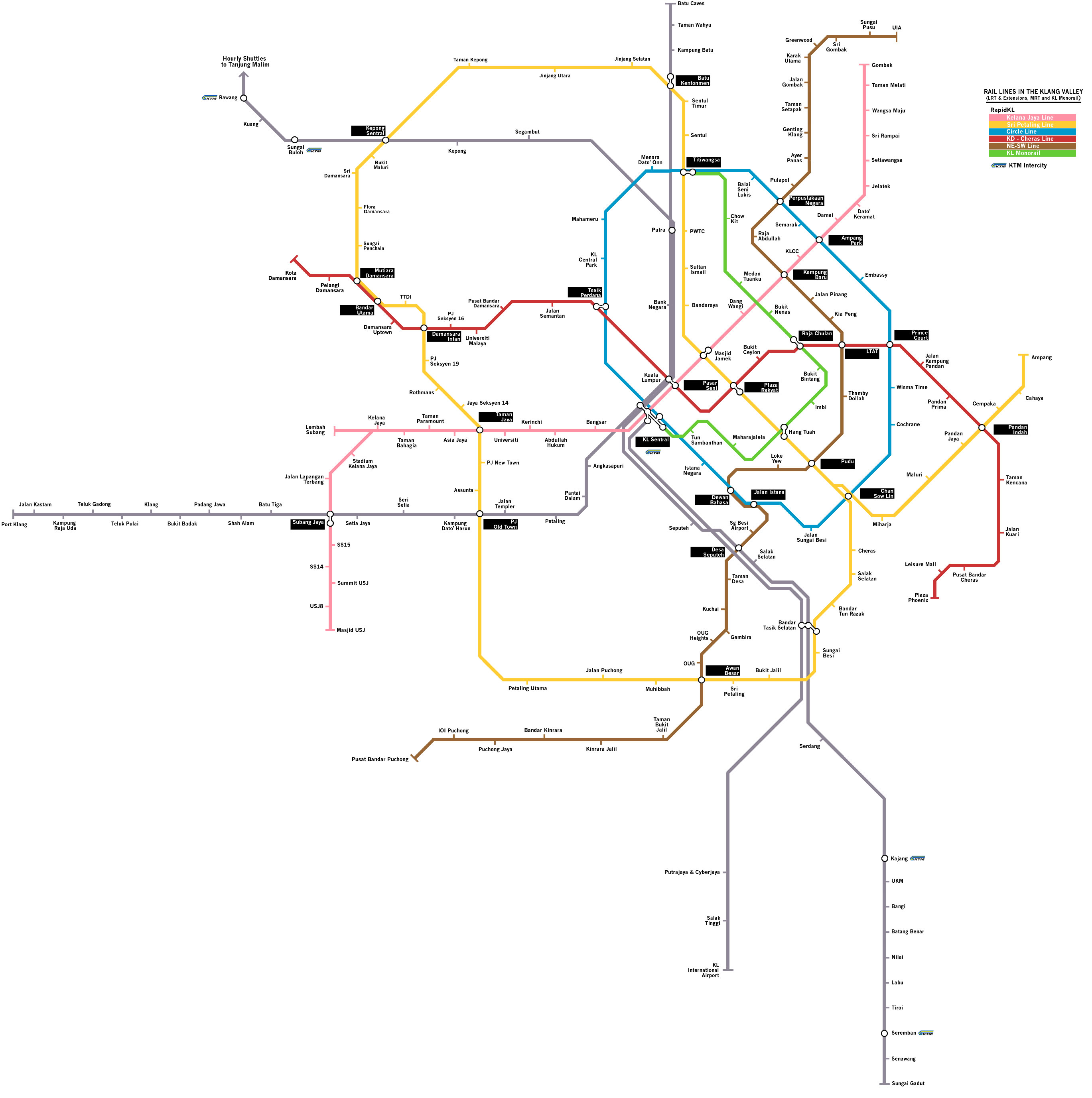
The current rail network for Klang Valley. Drawing courtesy of @Bukhrin

The current proposed LRT extensions from Prasarana – drawing courtesy of @Bukhrin

The current proposed LRT extensions from Prasarana along with a new proposed line serving the northwest-southeast corridor – drawing courtesy of @Bukhrin.

This proposal from Fikir Runding in 2007 with the key feature of radiating lines and two circle lines – drawing courtesy of @Bukhrin.


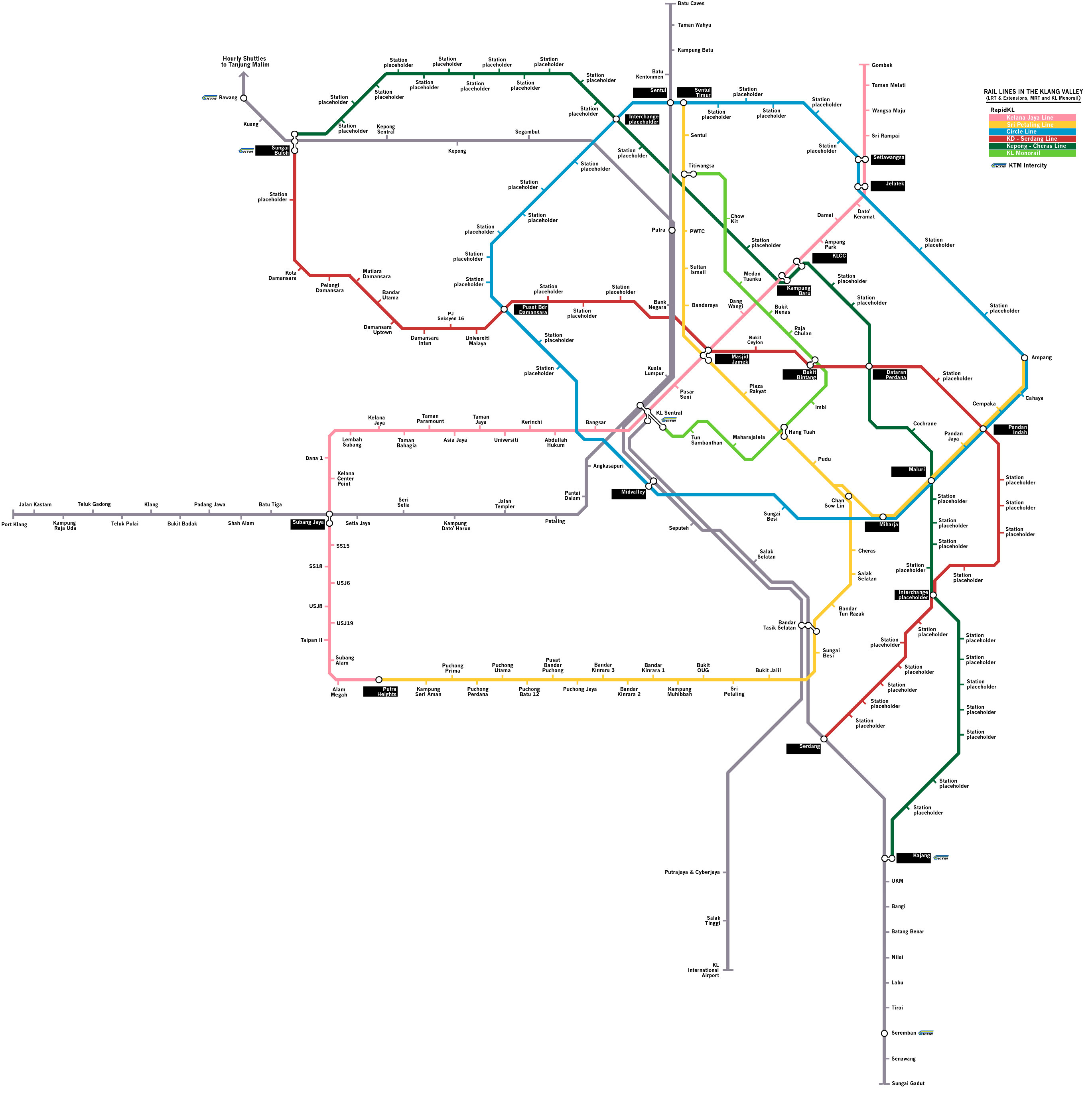
MMC-Gamuda proposal for Klang Valley rail network from 2010 – drawing courtesy of @Bukhrin

Graphic from the Malaysian Insider shows proposed phases for the "unsolicited", "unapproved" MRT project. MMC-Gamuda would like very much for this project to get started next year.

The StarBiz "snapshot of the MRT proposal" showcasing its "advantages" - Image courtesy of Star Biz

StarBiz graphic showing the proposed routing for the City Circle Line

The Gamuda-MMC proposed MRT network consists of two radial lines and a circle line, which has similarities with the train networks in most major cities. It is commonly known as the “wheels and spokes” concept.

In total, the MRT network will cover up to 150km of lines, with about a third of that going underground.

The first radial line, dubbed the red line, will go from Damansara to Serdang and the second one (the green line) will be from Kepong to Cheras.

Both lines will cross the centre of Kuala Lumpur city and will converge in the city centre, at Dataran Perdana near Jalan Tun Razak.

Multiple “Seamless” Interchanges

The proposal suggests that there is a need for additional interchanges between LRT and MRT stations in the Klang Valley and will plan the MRT lines to maximize the number of available interchanges.

The interchanges are also being described as “seamless” and designed in the same manner as interchanges in Hong Kong, Singapore and Kaohsiong.

Similar interchanges are proposed for the Fikir Runding, DBKL and Prasarana proposals, at different sites. For example, Prasarana proposes that KL Sentral stay as a main interchange, while the MMC-Gamuda and DBKL proposals seem to prefer Masjid Jamek.

[KVMRT: Interchanges and network nodes are very important aspect in the network and having many interchanges will allow better flow of passenger movement throughout the network. In addition, the development potential for sites around interchanges is high - which can help to offset the cost of construction.

After having been exposed to the poorly designed interchanges in the existing rail network (particularly Kuala Lumpur-Pasar Seni and KL Sentral-KL Monorail) we do not think there would be objections to this.]

Underground construction
The proposal from MMC-Gamuda has a idea of utilizing underground construction proposed for the two main lines along the “northwest-southeast” corridors. Most of the City Centre line would be elevated (except the western stretch).

This contrasts interestingly with the DBKL proposal (which consists mostly of elevated monorail lines) and the Prasarana proposal (which will only be underground from Brickfields to Bukit Bintang). We have no details about the Fikir Runding proposal.

[KVMRT: As you can imagine, the cost of underground construction is almost twice higher than the cost of elevated construction - and with MRT trains being wider than LRT trains, the rolling stocks cost will surely be higher.  There is also the issue of the land under KL - which has many open caverns and underground rivers. It will be challenging task for engineering aspect in proper corridors for tunneling.]

Rail good, bus bad
All of the proposals above are rail-based, and they mostly argue that the existing bus system will not be able to meet future public transport demand.

While the proposals (with the exception of Fikir Runding) do have varying degrees of bus usage incorporated in the design, it is clear that rail is in great favour.

The MMC-Gamuda proposal goes ahead to say that the SPAD proposal for bus lanes and BRT is unworkable because of congestion (shown in photos) on the existing roads where these routes have been proposed.

The MMC-Gamuda proposal takes a highly “selective” (biased) approach by using a photo of the TransMilenio BRT system in Bogota that suggests that the system will simply lead to more traffic congestion.

[KVMRT: Selection examination of the details and all the options is nothing new.

The key issue is what is behind that selective examination of the details. Can DBKL, Prasarana, Fikir Runding and MMC-Gamuda say that they do not have a huge financial stake in the future rail network for the Klang Valley?

That is why these proposals should be examined publicly, in an open and transparent manner - so that the ideas, thoughts, feeling and biases become clear and what emerges is the best possible choice.

It is also why we really prefer it that proposals do not come to the government from companies that have a direct interest in the proposal. ]


Feedback
Klang Valley MRT admin needs your feedback on the above proposals – evaluating the advantages and disadvantages – and suggestions on what network would be best for the needs of the Klang Valley.


Thank you for staying tune with KVMRT. The above analysis is done with close reference to TRANSIT.