Tuesday, September 27, 2011

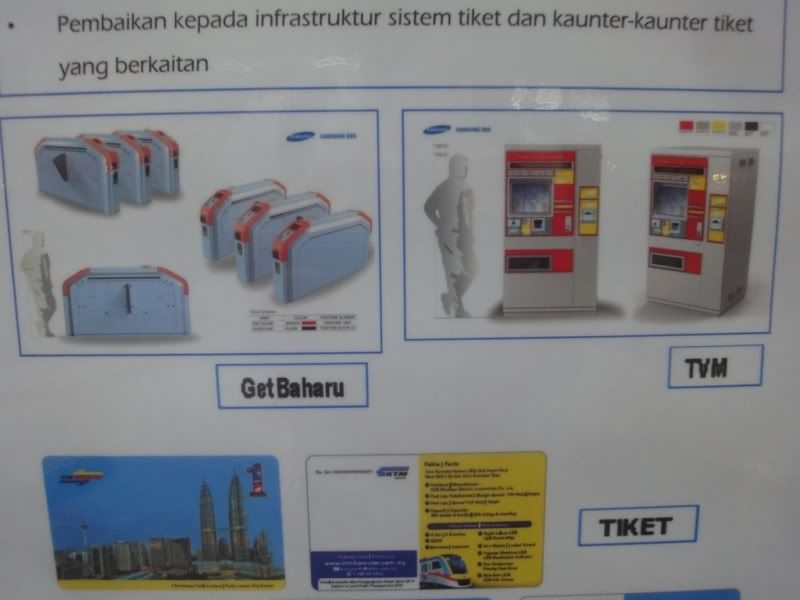
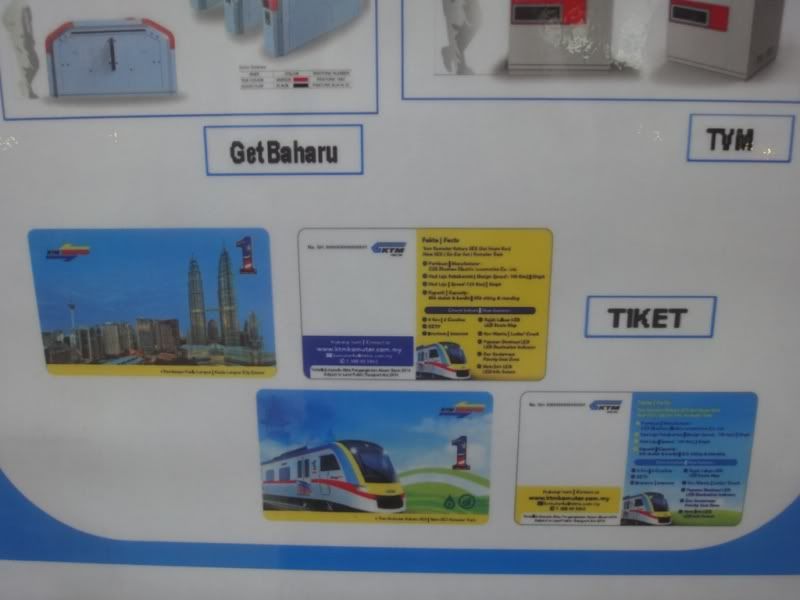
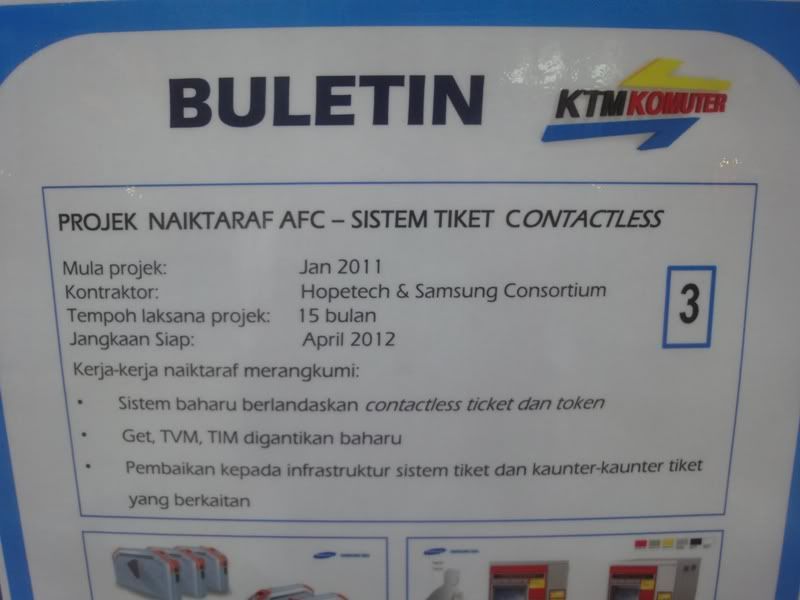
New ticketing system for KTM

KVMRT has found out photos that put KTM Komuter new ticketing system in details. As such the three divided photos (below) tell whole storyboard.

From it, we can assume that tokens are used for integration between RapidKL Rail (LRT and Monorail) and KTM Komuter. Meanwhile a new magnetic contactless card is for normal KTM Komuter transactions.

On information RapidKL's AFC, click here.


Saturday, September 24, 2011

KTM gets first batch of SCS

KVMRT took this opportunity to compliment KTM who received the first batch of six electric train coaches (SCS) with witness for Transport Minister. This is definitely a reason for commuters to cheer about, soon if not now.

KTM gets first batch of electric train coaches from China (The Star)

Friday September 23, 2011

PORT KLANG: Keretapi Tanah Melayu Berhad (KTM) has received the first batch of six electric train coaches from the Transport Ministry.

Its minister Datuk Seri Kong Cho Ha said the Six-Car-Set (SCS) manufactured by China's Zhu Zhou Electric Locomotives Co Ltd were shipped from Shanghai Port on Sept 13 and reached Westport at 2am yesterday.

“Unloading work began from 8am and was completed at 5pm,” said Kong, who was at the presentation ceremony at Wharf 3, Westport in Port Klang.

He said the coaches were part of the 38 new sets for the KTM Komuter service which are being financed via allocations from the Federal Government under the sixth initiative of the National Key Results Area programme.

“Under this initiative, RM1.894bil has been spent to buy the 38 sets which will help improve the quality of the KTM Komuter service,” Kong said.

He said delivery of the sets would be in batches and completed by May next year.

First batch: Kong (in tie) inspecting one of the electric train coaches in Port Klang Thursday.

“The coaches will undergo operational and security tests before they are deemed safe for use,” he said, adding that it would take one to two months to test each set.

“The sets will be sent to the depot in Batu Gajah Perak for tests. The first train is expected to start service by December.”

Kong said his ministry was optimistic that with the new trains, the schedule of train arrivals could be shortened from 30 minutes to just 10 minutes and the target to increase capacity from 95,000 commuters to between 150,000 and 200,000 would be achieved.

Latest: MyKomuter launched

Wednesday, September 21, 2011

KTM Update: Six-car train sets to arrive

KVMRT take note of this news article about new six-car train sets (SCS) that would arrive at Port Klang on Sept 23. Below are the details and interior views of the new SCS. An exhibit on details of the new Komuter was set up at KL Sentral for public display.

KTMB buys 38 new trains (The Star)

Monday September 19, 2011

KTMB president Dr Aminuddin Adnan, who is aware of the various problems faced by commuters, said they have bought 38 new six-car train sets (SCS) after an allocation of RM1.8bil was pumped in through the National Key Result Area project.

“The first set of SCS is scheduled to arrive at Port Klang on Sept 25.

“Another five more sets will be delivered between November and December, while the remaining 32 are scheduled to be delivered in stages from January to June 2012,” he told StarMetro during an interview recently.

Sleek: A picture of the new six-car train set put up by KTM at KL Sentral for public display.

He said the first batch of SCS would be sent for commissioning and testing by the manufacturer, CSR Zhuzhou Electric Locomotive Co Ltd, and monitored closely by Land Public Transport Commis-sion.

“The tests will include how it responds to our signalling system, functions of braking and door systems as well as realiability of the train,” said Dr Aminuddin, adding that about 95,000 commuters were using the KTM Komuter trains daily.

“To ease congestion, we are using two sets of the Electric Train Services.

“The new trains will enable us to accommodate 150,000 to 200,000 passengers daily,” said Dr Aminuddin, adding that the first batch would only be operational from January 2012 onwards.

KTMB has set up an exhibit on details of the new Komuter at KL Sentral for public display.

Spacious: A picture of the interior of the new six-car train set

Called My Komuter, the train has a design speed of 140km per hour and an operating speed of 120km per hour.

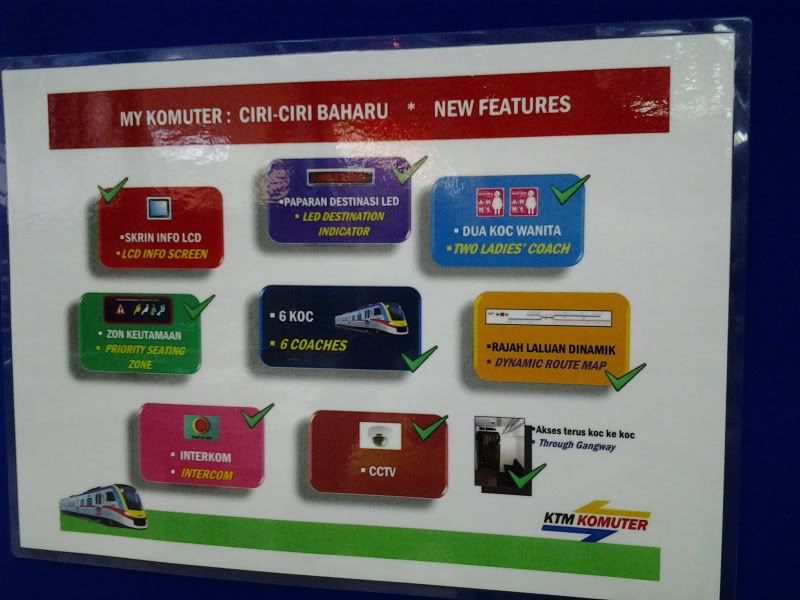
Newly-added features of My Komuter include LCD info screens, LED destination indicator, two coaches for women, priority seating zone, dynamic route map, intercom and CCTV.

KTMB now has 53 stations with the addition of two new ones in Sungai Gadut and Senawang to take passengers from Batu Caves to Sungai Gadut and Tanjung Malim to Port Klang.

KTM Komuter started its services with 64 Electric Multiple Units. On Aug 3, 1995, the first KTM Komuter train began taking passengers from Kuala Lumpur to Rawang. Free trips were offered until Aug 11, 1995.

It began operating commercially between these two destinations and then extended to Salak South on September 1995.

From then on, it gained popularity among commuters, who do not want to be caught in traffic congestion.

It was reported that KTM Komuter contributed RM84.63mil to group revenue in 2006, higher than KTM Intercity’s profit of 70.94mil in the same year.

According to the Transport Ministry’s 2008 statistics, the ridership for the KTM Komuter is about 36.557 million passengers per annum.

However, over the years, its services had deteriorated considerably due to poor maintenance.

Limited spare parts has also resulted in most coaches being left in the depots, thus affecting frequency of service.

Lack of funds and expensive spare parts have also led to the deterioration of service.
Other related stories:
Never-ending struggle
KTMB to add new features for wait time and security


New features of My Komuter

For more pictures of the new My Komuter, link is at here.

Wednesday, August 24, 2011

MRT Update: Chinatown land acquisition (Update #2)

Jalan Sultan traders to keep buildings after MRT tunnelling finishes (Malaysian Insider)
By Shannon Teoh

August 23, 2011

A view of the Jalan Sultan area where some buildings had been earmarked for demolition. — Picture by Jack Ooi

KUALA LUMPUR, Aug 23 — The 31 landowners in Chinatown will be able to hold on to their property after the government agreed to reinforce their buildings before allowing them to return after tunnelling for the Klang Valley Mass Rapid Transit (KVMRT) under their shops is completed.

Datuk Seri Dr Chua Soi Lek told reporters that an agreement in principle had been reached after a one-hour meeting this afternoon with the Land Public Transport Commission (SPAD) and most of the 31 traders in Jalan Sultan in the capital.

“The government will proceed with acquisition but also strengthen the buildings that are affected for safety of the household,” the MCA president said.

The century-old Chinatown was planned for demolition due to the RM50 billion KVMRT project but loud protests from residents, who say they were informed less than two weeks ago, have forced the government to backtrack over plans to redevelop the tourist attraction.

The 31 landowners will now be able to return to their buildings after tunnelling, expecting to take six months, is completed.

When quizzed by reporters, the former health minister said the government has in principle agreed to undertake the costs of the solution but that “details will be discussed. The cost of compensation and strengthening needs to be worked out.”

At a press conference after the meeting, Lee Shan Too, president of the Yan Keng Benevolent Dramatic Association located in Jalan Sultan, also told reporters that stratum titles under the National Land Code were the main option being considered.

A 1990 amendment to the National Land Code 1965 allows for the acquisition of underground land without affecting the property on the surface.

However, both Dr Chua and the traders insisted that legal details will be discussed later.

“Our final stand is that the land will remain with us and Chinatown will be intact,” said Thomas Tan, who owns the 73-year-old Lok Ann Hotel on the street.

“It is a win-win situation which will save the identity of Chinatown,” said Dr Chua.

Lee also said that the solution would reduce the government’s expenditure as “acquiring all our land titles would cost hundreds of millions” of ringgit.

Earlier today, state-owned Syarikat Prasarana Negara Berhad (Prasarana) said that it will explore the use of stratum titles for property owners affected by tunnelling for the KVMRT.

The Malaysian Insider understands that the government may still invoke the Land Acquisition Act to acquire the land titles before releasing the surface land back to the landowners if any of the 31 were to hold out against signing over the underground portion of their land.

A source said that the 31 buildings affected could withstand tunnelling if they were strengthened as they were only located within a “safety buffer” at a 45-degree angle from the actual tunnel itself which would run directly under Jalan Sultan.

Other news:
KL Chinatown traders can stay on (The Star)

By Yuen Meikeng

Tuesday August 23, 2011

KUALA LUMPUR: The 31 shop lots near Jalan Sultan will not be demolished for the construction of the Klang Valley My Rapid Transit (MRT) project, MCA president Datuk Seri Dr Chua Soi Lek said.

He said the shops would remain as they are an important part of KL Chinatown's identity.

"During the six months of constructing the MRT tunnel underneath the area, the occupants will have to evacuate their property but will be told to return after that.

"Buildings affected by the construction will be strengthened," he told reporters after attending a dialogue between the Land Public Transport Commission (SPAD), representatives of the Jalan Sultan traders and others at the SPAD headquarters here Tuesday.

Monday, August 22, 2011

MRT to acquire part of KL’s Bukit Bintang

MRT to grab part of KL’s Bukit Bintang shopping district (Malaysian Insider)

By Boo Su-Lyn

August 22, 2011

A general view of the proposed site for the Bukit Bintang MRT station

KUALA LUMPUR, Aug 22 — Twenty lots in the capital city’s main shopping district, Bukit Bintang, will be acquired for the Klang Valley Mass Rapid Transit (MRT) to make way for tunnelling works and an underground station, operator Syarikat Prasarana Negara Bhd (Prasarana) said today.

Prasarana project development director Zulkifli Mohd Yusoff said the lots along Jalan Bukit Bintang, Jalan Imbi, Jalan Jati, Jalan Inai, Jalan Kamuning, Jalan Kampung and Jalan Utara would be acquired under the Land Acquisition Act 1960.

They include two fast-food restaurants — McDonalds and KFC — a Porsche car showroom, a batik gallery, a private club, offices and residential properties, landowners told The Malaysian Insider today.

Jason Ng, who said nine of his lots would be acquired, asked why landowners were not allowed to keep their properties above the underground tunnel running from the Bukit Bintang Central to the Pasar Rakyat stations.

The business legal advisor pointed out that the National Land Code 1965, which was amended in 1990, allowed the acquisition of underground land without affecting surface property.

“You’re robbing people and paying Prasarana or SPAD (Land Public Transport Commission). You’re going to acquire my land to build activities later on,” said Ng at the briefing.

Zulkifli, however, denied that the government would develop the prime land in the Golden Triangle, saying: “We can’t do anything because of the safety of the tunnel.”

Batik gallery owner Colin Yong told reporters that the landowners received notices under Section 8 of the Land Acquisition Act early this month.

“My family owned (this business) for 30 over years,” he said.

But Zulkifli stressed that the government was trying to minimise land acquisition by stacking the platforms of the underground Bukit Bintang Central station.

Prasarana also announced recently that land in Jalan Sultan would be acquired despite opposition from the Chinatown community who called it a heritage area.

According to Prasarana, construction on the Sungai Buloh-Kajang (SBK) line would begin in November this year.

The multi-billion ringgit project is expected to be completed in 2016 and will begin operations in January 2017.

The SBK line will cover a distance of 51km, of which 9.5km will be underground. Seven of the 31 stations from Semantan to Maluri will also be underground.

More to come


View Larger Map

Previous Alignment
Bukit Bintang East

Bukit Bintang West