Showing posts with label Sg. Buloh – Serdang – Putrajaya Line. Show all posts

Friday, December 9, 2016

Sungai Buloh – Serdang – Putrajaya Line

MRT Sungai Buloh Serdang Putrajaya Line station

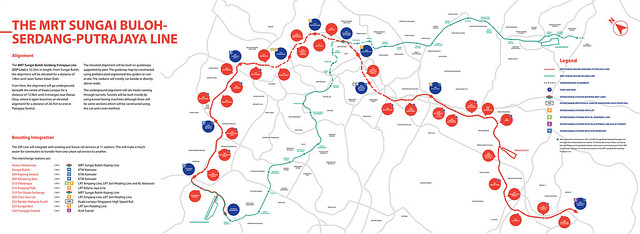
The DEIA report of Sungai Buloh – Serdang – Putrajaya Line has outlined the alignment options for KVMRT Line 2.

The preferred alignment then was decided based on an evaluation of various factors including the route should improve connectivity to present and future major developments and to areas that have potentially high ridership, the route must facilitate regeneration in areas such as the Batu Kentonmen area, Tun Razak Exchange development and Jalan Cochrane redevelopment.

The route should provide connectivity to existing/ planned railway and public transport systems including the KTM Komuter, LRT and monorail lines, should utilise highway land and other government reserves so as to minimise private land take and lastly the social and environmental impacts should be kept to a minimum.


The above is MRT SSP Line proposed alignment during the public viewing session.

Technical information
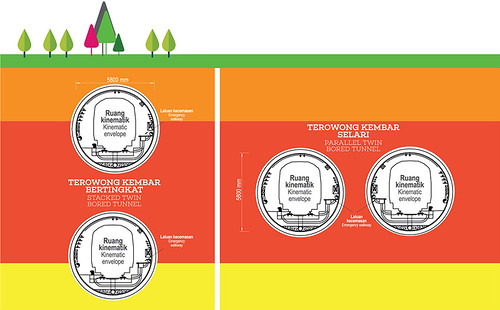
As precedent to SBK Line, two different structures will be used; elevated guideway and tunnel for underground.

A key decision for the SSP Line is the extent of elevated track. It would be inappropriate for the railway to be either completely elevated or completely underground. An elevated railway through the centre of Kuala Lumpur would significantly detract from the quality of the streetscape, and would almost certainly be impracticable in any event.

On the other hand, a completely underground alignment would increase both the capital and operating costs of the line. The railway needs to be cost-effective, and a fully underground alignment would be difficult to justify financially or economically. A secondary point is that travel on the railway is more pleasant above ground.

Where to make the transition from elevated to underground is an important question because transitions take up a great deal of space, and it is difficult to find suitable locations.
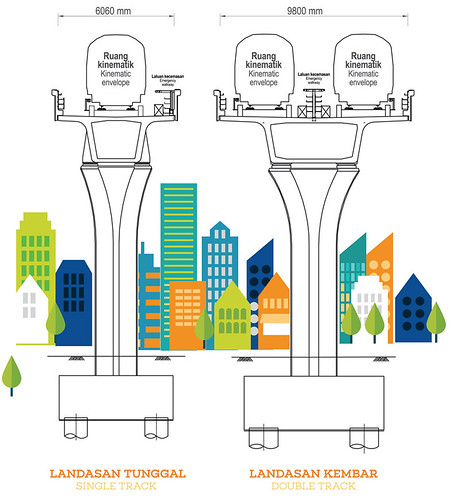
Elevated

Tunnels

Sunday, November 20, 2016

MRT Line 2 contracts

The upcoming Klang Valley MRT Line 2 project linking from Sg. Buloh via Serdang to Putrajaya will be giving contracts soon.

From sources quoted, contracts worth RM23mil is believed to tag both Line 1 & 2 to be one of the most expensive rail projects in terms of costs per km.

The line will consists of 31 elevated and nine underground will cover Kepong, Jalan Sultan Azlan Shah (Jalan Ipoh), Kampung Baru, KLCC East, Pandan Jaya, Pandan Mewah, Plaza Phoenix and The Mines in Serdang.

The final station in Putrajaya Sentral is marked as its 40th station.


Sunday, May 19, 2013

KVMRT Line 2

Klang Valley Mass Rapid Transit Line 2 will be even bigger than the first line. The new line is longer than the predecessor, it will have a longer underground section and more stations. That means it will cost more too.


Initial estimates peg the cost of Line 2 at RM24.9bil once the line is extended from Serdang to Putrajaya. Construction of the proposed second line will be done in two stages with the first stage up to Serdang. The cost of that will be similar to that of the first line.

The main difference between the first and second line though will be ridership.


Estimates show that 20% more people, or 550,000 passengers a day, will traverse through line 2 as opposed to 460,000 a day for Line 1.

In terms of passengers per km, Line 2 is expected to ferry 11,100 passengers per km compared with 10,000 passengers per km for Line 1.

Projections also show that Line 2 will carry 40% more people than Line 3, or the circle line, upon completion.

The reason for the higher ridership is that Line 2 will cut through more densely populated and lower income areas. Neighbourhoods such as Damansara Damai, Kepong, Batu Kampung Pandan, Kampung Baru, Sentul and Serdang are large catchment areas of people.

The alignment of Line 2 will also cut near to areas where PR1MA is expected to build affordable housing for Malaysians. Areas such as Sungai Buloh, Kentonmen and Serdang where PR1MA is expected to build mass affordable housing

Both Line 1 and 2 are expected to converge at the Tun Razak Exchange which will enable passengers to interchange onto other lines. [KVMRT: For the whole 51km MRT Line, the only interchange station is at Tun Razak Exchange, how is it possible for passengers flow? Assuming 10% of Line 1 disembark and 20% of Line 2 interchange, it will see about 46,000 and 110,000 passengers at one particular station.]

Line 2 will also serve the KLCC area as it will cut through the middle of the city centre as opposed to the Light Rail Transit line that serves the northern part of the development.


A decision to proceed with Line 2, which is a radial line instead of the circle comes down to catchment and ridership.

Normally, like in the case of Singapore, the circle line will come last. They will do the radial lines first. It's because the radial lines will help you build up the catchment and ridership. The circle line just connects the lines for you. The priority is to first build the network and its catchment.

Ringgit and sen wise, Gamuda points to the study by Halcrow on the economic internal rate of return (EIRR). It claims that the consultant had put an EIRR at 27% which captures the social benefits of the project, value of time and the multiplier impact of the MRT project.

Article read: Will MRT Line 2 go on as planned? (The Star)

KVMRT network structure
According to the the National Land Public Transport Masterplan (final draft), the KVMRT Line 2 or the North-South Line is meant to link developing areas such as Sungai Buloh, Kepong and Selayang with the eastern side of the city centre including Kampung Baru and Tun Razak Exchange.

The third line or the circle line should provide an orbital link between areas such as Mid Valley, Mont Kiara, Sentul Timur, Ampang as well as the planned Matrade.

The KVMRT project, consisting of three lines, is expected to have a total network of 145 km.

By the time the KVMRT Line 1 is completed in 2017, it is expected to carry some 384,000 passengers daily.

A MRT rail system would require some 20,000 passengers per hour per direction to be feasible.


[KVMRT: Technically, one should never define a MRT system as 20,000 pphpd. It is not widely accepted in international standard.]