Showing posts with label KTM Komuter. Show all posts

Wednesday, December 28, 2011

Improved Komuter service this February

MRT admin is back and come with good news for commuters using KTM Komuter service. The 6-car train set will come into operation next February 2012, this appeared to be a 'delay' from the earlier expected January 2012 operation.

KTMB's Commuter Service Gets A Boost (Bernama)

December 27, 2011

BATU GAJAH, Dec 27 (Bernama) -- Keretapi Tanah Melayu Berhad (KTMB) commuter service is expected to get a shot in the arm in February when four of the 38 six car sets (SCS) it purchased become operational.

Its president Dr Aminuddin Adnan said this would help overcome problems like delays and lack of coaches faced by the service, which was currently using the three-coach Electric Multiple Unit (EMU) sets.

"We currently have 25 EMU sets but half of them need to be restored. However, we cannot do so because of inadequate sets because the others are constantly in use. This often cause delays," he told reporters at the KTMB Complex here, today.

He said for the same reason (not enough sets), KTMB could also not increase the frequency of the service.

Meanwhile, Land Public Transport Commission (SPAD) chairman Tan Sri Syed Hamid Albar said although KTMB was supposed to introduce the SCS sets this year, but postponed to next year in order not to compromise on safety.

He said this was because each of the train set which could accommodate 1,000 passengers needed to follow specifications, laws and international standards.

KTMB had received nine of the 38 SCS sets and four more were expected to arrive in January while the balance would be delivered in stages until June 2012, he said.

"The frequency of the service will be improved to every 10 minutes with 63 train units - 38 SCS train sets plus 25 EMUs - which will be available by June 2012," he said.

Other news:
KTMB plans to invest RM1bil in 20 more electric coaches (The Star)- link

Sunday, August 7, 2011

New trains to cut KTM Komuter waiting time

New trains expected to cut waiting time at KTM Komuter lines (The Star)

KUALA LUMPUR: When the newly-acquired trains from CSR Zhuzhou Electric Locomotive from China are put into service for the KTM Komuter lines by the end of this year, train commuters can look forward to shorter waiting times during peak hours.

Commuters on the Rawang-Sungai Gadut, Batu Caves-Port Klang, Sentul-Port Klang and Batu Caves-Rawang routes will benefit from the additional capacity from the trains, technically known as electric multiple units or EMUs.

The first of the 38 EMUs will arrive next month and will be tested before they are put into service.

About 100,000 commuters jam KTM Komuter trains daily during weekdays to travel in about 20 sets of EMUs of three cars each available to them.

From a schedule of 15-minute intervals at one time, which theoretically required at least 36 EMUs to be provided each day by Keretapi Tanah Melayu Bhd (KTMB), this has since slowed down to 20-minute intervals or, which theoretically means 25 EMUs.

But KTMB does not even have the luxury of 25 EMUs.

Since September 2009, their availability has been down to around 21 EMUs daily because of broken down trains that have not been repaired from 62 EMUs at one time.

On bad and unfortunate days, this can sink to a precariously low of 15 to 18 EMUs per day.

Hence, delays of 40 minutes or more on certain sectors are not uncommon with KTM Komuter trains always packed like sardines during weekdays.

This also amplifies the fact that there is no shortage of passengers for KTM Komuter trains in view of its relatively cheap cost as it only costs RM6 from KL Sentral to Seremban.

Transport Minister Datuk Seri Kong Cho Ha told Bernama that the government had decided to improve the situation through a number of initiatives under the National Key Result Areas (NKRA) for public transport.

The NKRA initiatives were launched in July 2009 by Prime Minister Datuk Seri Najib Tun Razak as part of the Government Transformation Programme (GTP) towards achieving Vision 2020 and improving the government's service delivery to the people.

Besides improving capacity, Kong said the measures were also to raise the daily ridership to 600,000 public transport commuters in the Klang Valley by the end of 2012.

This target, he said, was 2.5 times more than the current ridership.

"It's a tall order for us but we are working hard to achieve our target," Kong said.

The current daily ridership is about 240,000 for public transport in the Klang Valley, estimated to represent 10 to 12 per cent of the total population in the country's busiest urban centre.

Kong explained that the Klang Valley's public transport services had already been filled to the brim, particularly for rail services (KTM Komuter, RapidKL, LRT and Monorail).

Such a pressing situation demanded the creation of an additional capacity for 360,000 more people to migrate to public transport from private vehicles, he said.

Of the potential increase, 58 percent or 207,000 will be for rail and 42 percent or 153,000 will be for buses.

Rail will be the biggest contributor, with KTM Komuter contributing around 95,000 passengers, the Kelana Jaya LRT line 62,000 and the Ampang LRT line 33,000.

The first step towards improving capacity took place at the end of 2010 when new four-car train sets were introduced on the Kelana Jaya LRT line, the most congested rail line in the Klang Valley, from the previous two-car train sets.

The initiative was to secure "quick wins" for the people's benefit under the NKRA for urban public transport. - Bernama

Other news:
Letters: No end of problems with KTM Komuter

Thursday, July 7, 2011

KTM EMU to arrive before Sept 2011


From Alan Ting
ZHUZHOU (Southeast China), July 6 (Bernama) — The first consignment of 38 Electric Multiple Unit (EMU) units of six-car trains ordered by Keretapi Tanah Melayu Berhad (KTMB) for commuter services will arrive in Malaysia before September, said Transport Minister Datuk Seri Kong Cho Ha.
He said the EMU, build by China state owned CSR Zhuzhou Electric Locomotive Co. Ltd (CSR ZELC) were well ahead of the schedule with the first consignment expected to be put into service before the end of this year.
“The delivery will be in stages with full delivery of the total 38 EMUs by June next year,” he told Malaysian reporters here after “the roll out ceremony” for the first of the 38 EMU sets of the six-car trains ordered by KTMB at SCR ZELC plant here.
Also present were the Governor of Hunan Province Xu Shousheng, chairman of CSR ZELC Zhao Xiaogang and KTMB President Dr Aminuddin Adnan.
KTMB has signed an agreement with ZELC, a well known China EMU builder on May 19 last year to purchase custom-build EMU sets of the six-car trains for commuter service in Klang Valley under the government’s National Key Results Areas (NKRA) for public transport. Kong said the custom build EMU specifically to run on Malaysia meter gauge (measuring one metre or 3 ft, 33/8 inches wide) which can travel up to 140 km/h.
He said the purchase of 38 EMUs cost RM1.89 billion and was awarded to ZELC based on the lowest price offered in their bid for the government procurement tender.
“The contract does not include Maintenance, Repair and Overhaul (MRO)which we are still looking into awarding soon,” he said.
The trains of six sets has a futuristic design, using latest train technology from China with two KTM engineers based here for the past three months to ensure all systems follow the specifications set by KTM.
Each train set is capable of carrying about 900 passengers and this means KTM can double its passenger transport rate as well shorten the waiting period from currently 30 minutes to 10 and to only seven and half minute at peak hours.
Meanwhile, Dr Aminuddin said the 38 new EMUs will be used to serve theroutes between Rawang-Sungai Gadut, Batu Caves-Port Klang, Sentul-Port Klang and Batu Caves-Rawang.
He said with the entry of new EMUs from China, the usage of “EMU hybrid’ will be reduced.
KTMB had introduced the use of EMU Hybrid trains since last year to overcome the problem of cancellation, delays and shortage of trains.
The KTM Komuter EMU Hybrid sets use diesel locomotive power with the help of power-generating car that provides electricity for their air-conditioners, public address system and automatic doors.
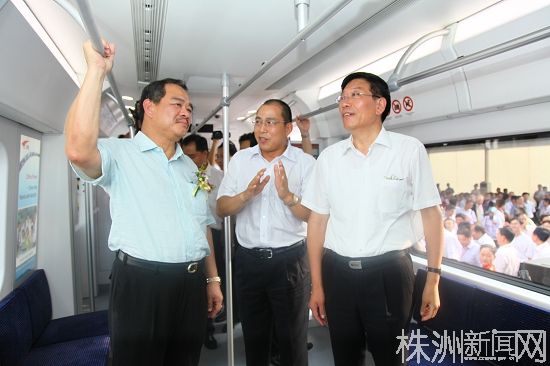
Minister of Transport officiated the 1st set of KTM EMU 6 car train in Zhuzhou, China


Tuesday, June 7, 2011

One ticket to ride

One ticket to ride (Malay Mail)

Smooth road-rail travel for Klang Valley by 2013 when two major transport operators’ electronic pass systems merge

By Shahrim Tamrin

Tuesday, June 7, 2011


KUALA LUMPUR: GOOD news beckons for public transport users in Klang Valley.

After more than 13 years for a single ticketing system ever since the introduction of ‘Touch n Go’, commuters can now look forward to seamless travel on rail networks and bus services across the Klang Valley come 2013.

With the objective to achieve gradually to the level of electronic ticketing in developed countries such as London’s Oyster and Octopus Card in Hong Kong, public transport efficiency in Klang Valley will reach a new height with Automatic Fare Collection (AFC) system.

After years of having to face different ticketing systems, preparing small change for exact fare and queuing up at counters, Syarikat Prasarana Negara Berhad (Prasarana) - the operator of the LRT, monorail and RapidKL bus services - and KTM Bhd (KTMB), which operates the Komuter service, have confirmed a single ticketing system would materialise soon.

Prasarana group managing director Shahril Mokhtar and KTMB president Dr Aminuddin Adnan revealed to The Malay Mail that a new AFC system would be adopted between both parties once it is in operation next year.

Shahril said Prasarana would be launching its own AFC system early next year, paving the way for an integration with the KTMB system at later stage.

“Once the AFC is up and running for our services early next year, we are ready to integrate with KTMB as their AFC system will also be on the same platform and design,” he said.

Shahril described the all-in-one ticketing system would offer a hassle-free journey for public transport users in Klang Valley.

“Commuters will only need to use just one cashless card for our LRT, monorail and bus services. It will take off early next year when the station integration works in Hang Tuah, Masjid Jamek and Titiwangsa are completed by the third-quarter of this year,” he said.

Shahril added that the AFC system would also be included for the future MRT and LRT extension services.

The station integration is considered to be the catalyst for Prasarana to launch the AFC system as it will ensure commuters experience seamless journeys without having to go through the hassle of buying different tickets or going through turnstiles to change rail routes.

Aminuddin said the KTMB AFC system for its Komuter service is currently being installed and the roll-out to all KTM’s 56 rail stations was expected to be completed in 12 months.

“The contractor will complete the AFC system for the KTM Komuter service by June next year. We will then start to commission the new ticketing system to replace the obsolete system we have right now," said Aminuddin.

New system will benefit commuters

“When everything is in place, we will discuss with Prasarana to merge the two systems as our new ticketing system design, specification and platform are almost similar to Prasarana’s ticketing.”

Both transportation leaders concurred the new AFC system for Prasarana and KTMB will bring greater benefits to the commuters for faster and more reliable transactions at the gates.

Stating the system would leverage on the present 'Touch n Go' platform, Aminuddin said: “The integration process between both parties would take couple of months to complete. It's most likely the ticketing integration between KTMB and Prasarana will take place in 2013.”

He also said that a common ticketing system was identified as part of the National Key Results Areas in the urban public transportation lab.

The lab had summarised seven big ideas in realising the government's objective of achieving 25 per cent usage of public transportation modal share by 2012.

At the Government Transformation Programme (GTP) Open Day in December 2009, urban transportation leaders had outlined seven big ideas - which include station integration and integrated ticketing across the Klang Valley, Bus Express Transit, extra carriages for KTM and LRT, Integrated Transport Terminal, Bus Rapid Transit and enforcement initiatives.

Lightning travel

NUR ISMAIL: We want to emulate the electronic ticketing success

HAVING a single electronic ticketing system is long overdue judging by the government's intention to implement this in public transport services for many years.

Land Public Transport Commission (SPAD) chief executive officer Mohd Nur Ismal Kamal said the government aims for a single cashless ticketing across operations to improve public transport.

“Ever since the introduction of the Touch 'n Go platform, it has been identified that a single cashless system be part of the mechanism to boost the quality of public transport. In future, the commission wants to see 90 per cent of commuters with cashless cards for seamless journeys and faster transaction,” he said.

The Touch 'n Go smart card was introduced in 1997 with the objective of a cashless society. It was first used at the then Jalan Pahang Toll Plaza in KL in March that year. The system was subsequently adopted by Klang Valley stage bus company Cityliner in 2000.

Mohd Nur pointed out the Automatic Fare Collection (AFC) system applied by government-backed public transport operators must be gradually extended to private companies.

“With AFC, this could soon pave the way for discounted fares and a kilometre-based system for many journeys to encourage more people to take up public transport," he said.

“We want to emulate the electronic ticketing success like that of London’s Oyster card and Hong Kong's Octopus card and thus gain public confidence in public transport ridership in Greater Kuala Lumpur.”

London's Oyster card was introduced in 2003 by local government body Transport for London (TfL) with the objective of reducing queuing times and speeding up journey times. It offers vast discounts on many journeys and environmental benefits as less paper tickets are used.

With Oyster, TfL is able to gather data on the most popular journey times and patterns.

Hong Kong's Octopus card was launched in 1997 by Octopus Cards Limited, a consortium of major transport operators for the territory’s mass transit system (metro, rail, bus and ferry) and widely recognised as one of the world’s leading automatic fare collection systems and contactless smart card payment system.

About 20 million Octopus cards are in circulation, three times the population of the former British colony, and it's used by 95 per cent of the population aged from 16 to 65 years, and generating over 11 million daily transactions every day worth a total over HK$100 million (about RM38 million).

Octopus can be used for more than 2,500 service providers across different businesses including transport, parking, retail, vending and kiosks, schools, leisure facilities and access control for residential and commercial buildings.

One seamless, cashless trip

JUST one cashless card for rail and bus services

The new cashless multi-modal ticketing card is expected to provide convenience to Klang Valley commuters by 2013.

For example, an office executive staying in Shah Alam and working in Pandan Indah can board the KTM Komuter train in the morning rush hour by simply tapping a cashless card before entering the platform.

Upon arrival at KL Sentral, she will simply touch the card at the exit gate and then walk to the elevated LRT station. She will then tap the same card at the LRT station to board the Kelana Jaya line train to the integrated Masjid Jamek station.

At Masjid Jamek, she walks up to another platform by using a special lane - without having to go through the turnstile at the Masjid Jamek exit - to board the Ampang line train. It is only at the Cempaka LRT station would the executive tap the card at the exit.

When she boards the RapidKL feeder bus from the LRT station to her office in the Pandan Indah business centre, she taps the same card for boarding and alighting from the bus.

It's one seamless journey without multiple tickets to improve accessibility and providing hassle-free connections.

Syarikat Prasarana Negara Berhad (Prasarana) group managing director Shahril Mokhtar said completion of integration stations at Hang Tuah, Masjid Jamek and Titiwangsa by third quarter of the year would hold the key to the activation of Automatic Fare Collection (AFC) system.

“The sooner works on station integrations are completed, the better. If possible, I want the AFC system to start by December,” he said.

For someone who regularly takes the LRT to work, Shahril has full empathy for the public call for one ticket for all.

“People have been waiting for this kind of system for many years. We are done with the planning stage and next year will be the crucial time for us to deliver,” he said.

He also said the cashless system initiative for bus services has already begun via Prasarana’s subsidiaries Rangkaian Pengangkutan Integrasi Deras (RapidKL).

Its new bus cashless ticketing system ‘Rabbit Card’ was introduced in February with encouraging response from passengers.

The RapidKL cashless system is considered to be as good as cash, with the aim to encourage rakyat to migrate to public transportation.

"I understand students prefer cashless card to travel by public transport around Klang Valley. It's convenient and hopefully people from all walks of life would take public transport including office workers and corporate executives."

Sunday, May 15, 2011

KTM Komuter frequency 7.5 mins by Sept

New trains to boost KTM Komuter service in Sept

SEREMBAN (May 12, 2011): The KTM Komuter will receive a boost this September when the first of 38 sets of six-car trains begin service to meet the growth in passenger traffic and also the addition of new routes such as Seremban-Gemas.

KTM Komuter Services General Manager Mohd Hider Yusoff said KTMB Bhd has forked out RM1.9 billion to purchase the trains.

"The first of the commuter trains of six sets with a futuristic design will arrive this year and the rest in 2012," he told reporter during a briefing on the new Seremban-Sungai Gadut commuter route which begins operations on May 14.

He said the trains will use technology from China and two engineers are now in the country to ensure all systems follow the specifications set out by KTM.

Each train set is capable of carrying about 900 passengers and this means KTM has doubled its passenger transport rate.

"We purchased the commuter from the Zelc company in China. Each commuter system can take six trains compared to three previously," he added.

He also said the additional trains would enable KTM to shorten the waiting period from 15 minutes to 10 and to only seven at peak times.

Based on KTM's long-term plan, the Seremban-Sungai Gadut route will be extended to Rembau, Tampin and Batang Melaka before ending in Gemas.

Meanwhile, on the occasion of the launch of the new route, the public are invited use the service free for seven days. — Bernama