Part 1 of Land Transport Masterplan 2013 here
As part of the Land Transport Masterplan 2013, two new MRT lines will be built and three existing lines will be extended. This will double the current rail network from 178 km to about 360 km.
The CCL will close the link between HarbourFront and Marina Bay stations and save commuters the hassle of making multiple transfers. The extension, which will also pass through Keppel, is expected to be completed by 2025.
The DTL will be two km longer by 2025 -- to run through the East Coast area. It will be connected to the East West Line and the Eastern Region Line, which will be ready by 2020, so that commuters can transfer between the Downtown Line and Eastern Region Line in the east.
The NEL will be extended northwards by one station to serve Punggol North including the new Punggol Downtown.
Showing posts with label SMRT. Show all posts
Saturday, January 19, 2013
Land Transport Masterplan 2013
[SG] More new MRT lines to be built by 2030
More new MRT lines to be built by 2030 (The Star)
Friday January 18, 2013
THE Government has announced a slew of new rail transit projects which will be completed by 2030.
By then, Singapore’s metro network will increase to 360km, from 178km today. The latest new rail projects were announced by Transport Minister Lui Tuck Yew during a visit to the Downtown Line 1’s Chinatown station yesterday morning.
The biggest project will be for a 50km MRT line running from Changi to Jurong that will be up by 2030.
Called the Cross Island Line, it will pass towns such as Loyang, Pasir Ris, Hougang, Ang Mo Kio, Bukit Timah, West Coast and Clementi.
Next is the 20km Jurong Region Line, expected to be completed by 2025, JRL will connect the Jurong region with the rest of Singapore. Commuters in the north will be also able to enter the Jurong area directly via the JRL, without having to interchange at the heavily-used Jurong East interchange. — The Straits Times / Asia News Network
Part 2 of Land Transport Masterplan 2013 here
Friday January 18, 2013
THE Government has announced a slew of new rail transit projects which will be completed by 2030.
By then, Singapore’s metro network will increase to 360km, from 178km today. The latest new rail projects were announced by Transport Minister Lui Tuck Yew during a visit to the Downtown Line 1’s Chinatown station yesterday morning.
The biggest project will be for a 50km MRT line running from Changi to Jurong that will be up by 2030.
Called the Cross Island Line, it will pass towns such as Loyang, Pasir Ris, Hougang, Ang Mo Kio, Bukit Timah, West Coast and Clementi.
Next is the 20km Jurong Region Line, expected to be completed by 2025, JRL will connect the Jurong region with the rest of Singapore. Commuters in the north will be also able to enter the Jurong area directly via the JRL, without having to interchange at the heavily-used Jurong East interchange. — The Straits Times / Asia News Network
Part 2 of Land Transport Masterplan 2013 here
Wednesday, May 18, 2011
Jurong East Modification Project
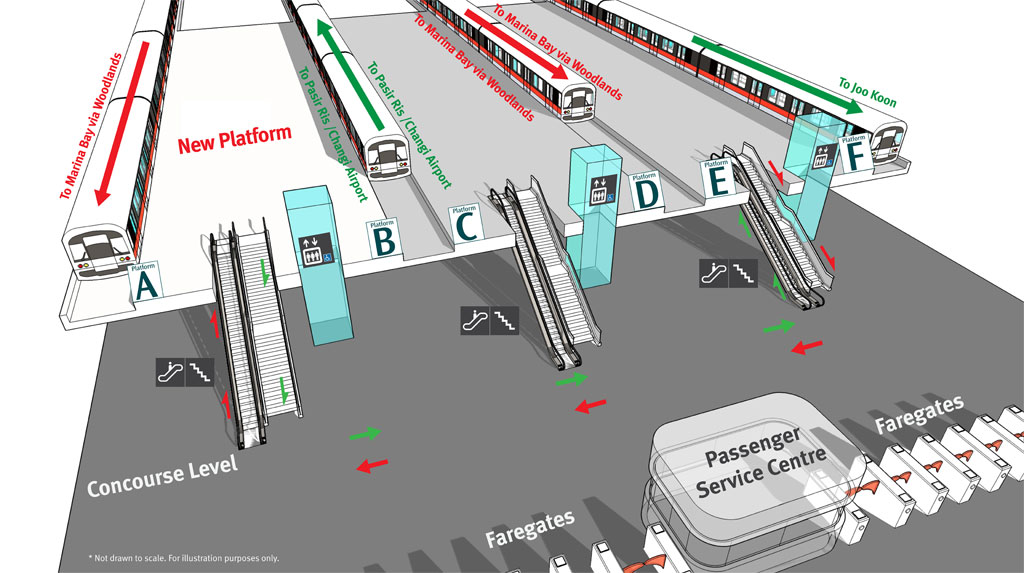
A new platform will be opened at the Jurong East MRT station on Friday 27 May 2011. The platform is part of the Jurong East Modification Project (JEMP). It will enable the deployment of additional trains on the North-South and East-West Lines (NSEWL) to ease crowding and increase capacity.
The new platform will allow five new trains to be deployed on the NSEWL from May 2011. By December 2011, another 17 new trains (on top of the five new trains) will be added, bringing the total number of new trains to 22. This will bring the total number of trains in service on the NSEWL to 128. With this, the carrying capacity on the two lines will expand by 15%. Commuters can look forward to shorter waiting times of 2 to 3 minutes at the busiest stretches, compared to the current 2.5 to 4 minutes.
For a start, from 27 May 2011, the new JEMP platform will be used during the morning peak hours, from 7am to 9am on weekdays (except public holidays), as this is the time period during which Jurong East Station is the most crowded. When more trains are delivered by December 2011, we will also open the platform during the evening peak hours.
Commuters will also be able to enjoy other improvements being made at the Jurong East MRT station. These include an additional entrance and a new passenger drop-off point for commuters working at the International Business Park as well as a pedestrian overhead bridge linking a new private bus pick-up point to the station. About 150 new bicycle racks have also been installed at the new entrance to the station for the convenience of commuters who cycle and ride as part of their daily commute. Please refer to Annex for the location of the new entrance.
Mr Chew Hock Yong, LTA Chief Executive said, "The Jurong East Modification Project introduces a new platform and a new commuter entrance at the Jurong East MRT station. It also involves the injection of 5 new trains from May and a total of 22 new trains by December. It is a major project to improve the capacity of the North-South, East-West Lines. The additional platform will allow more trains to be run at shorter intervals so that commuters can benefit from shorter waiting time and a more comfortable journey. This project is a key part of LTA's plan to significantly enhance Singapore's MRT network."
3D image of the new platform (SMRT image)
Getting Around
Jurong East MRT station is an interchange station providing connections between the North-South and East-West Lines. As with all interchanges, commuters may need to change platforms to transfer to another line.
To get around, commuters only need to remember these four easy steps:
i) Listen to the audio announcements in the train and at the station;
ii) Check the train platform and schedule on the Passenger Information Display screens;
iii) Follow the signs at the concourse and platform to find their way; and
iv) Ask the service ambassadors or staff if they need help.
Friday, April 8, 2011
MRT train disruption affects 17,500 commuters
A distruption to train services on Thursday morning inconvenienced 17,500 commuters. ST Photo: Ng Sor Luan
A DISRUPTION to train services on Thursday morning inconvenienced 17,500 commuters.
[KVMRT: This is a good example by which an 'efficient' MRT systems fail at a certain time. Singapore MRT existed since 1970s and is never problem free i.e disruption, as opposed to some Malaysians who claimed SMRT never delays.]
An eastbound train stalled at 8.49am due to a fault in the train, according to an SMRT spokesman.
Westbound and eastbound trains were turned around at Queenstown MRT Station and Outram Park MRT Station respectively to maintain services.
Eastbound train service resumed at 9.50am.
SMRT apologises for the inconvenience caused.
A distruption to train services on Thursday morning inconvenienced 17,500 commuters. ST Photo: Ng Sor Luan
A DISRUPTION to train services on Thursday morning inconvenienced 17,500 commuters.
[KVMRT: This is a good example by which an 'efficient' MRT systems fail at a certain time. Singapore MRT existed since 1970s and is never problem free i.e disruption, as opposed to some Malaysians who claimed SMRT never delays.]
An eastbound train stalled at 8.49am due to a fault in the train, according to an SMRT spokesman.
Westbound and eastbound trains were turned around at Queenstown MRT Station and Outram Park MRT Station respectively to maintain services.
Eastbound train service resumed at 9.50am.
SMRT apologises for the inconvenience caused.
Loses both legs being hit by MRT train
Thai teen loses both legs after being hit by MRT train
By Jalelah Abu Baker
Peneakchanasak Nitcharee (above), 14, who came here three weeks ago to learn English, being carried out of Ang Mo Kio MRT station by officers from the Singapore Civil Defence Force on Sunday. Photo: Lianhe Wanbao
A 14-YEAR-OLD Thai girl who fell onto an MRT track at the Ang Mo Kio station has lost both her legs.
One was severed by a train as it came into the station, and the other was so badly mangled that it had to be amputated by doctors.
It is not known why Peneakchanasak Nitcharee fell onto the track in the above-ground station at about 11am yesterday, but according to Shin Min Daily News, she had a dizzy spell while waiting on the platform.
Lianhe Wanbao reported that she had come here to stay with a relative in Ang Mo Kio three weeks ago to learn English, and was supposed to return to Thailand on Saturday.
The station at Ang Mo Kio is among the 25 slated to be fitted with sliding doors aimed at preventing such falls; 11 other above-ground stations already have such 1.6m tall doors.
Officers from the Singapore Civil Defence Force (SCDF) who arrived at the scene of the incident deployed a scoop stretcher - used only in confined spaces - to lift the injured girl off the tracks.
An SCDF spokesman, noting that she was conscious throughout the rescue operation, said her lower limbs were seriously injured.
The area was cordoned off and blue slippers (above), believed to be the girl's, were found on the platform. -- Photo: Shin Min Daily News
Nitcharee's guardian (right) with an unidentified man at Tan Tock Seng Hospital. Photo: Lianhe Wanbao
By Jalelah Abu Baker
Peneakchanasak Nitcharee (above), 14, who came here three weeks ago to learn English, being carried out of Ang Mo Kio MRT station by officers from the Singapore Civil Defence Force on Sunday. Photo: Lianhe Wanbao
A 14-YEAR-OLD Thai girl who fell onto an MRT track at the Ang Mo Kio station has lost both her legs.
One was severed by a train as it came into the station, and the other was so badly mangled that it had to be amputated by doctors.
It is not known why Peneakchanasak Nitcharee fell onto the track in the above-ground station at about 11am yesterday, but according to Shin Min Daily News, she had a dizzy spell while waiting on the platform.
Lianhe Wanbao reported that she had come here to stay with a relative in Ang Mo Kio three weeks ago to learn English, and was supposed to return to Thailand on Saturday.
The station at Ang Mo Kio is among the 25 slated to be fitted with sliding doors aimed at preventing such falls; 11 other above-ground stations already have such 1.6m tall doors.
Officers from the Singapore Civil Defence Force (SCDF) who arrived at the scene of the incident deployed a scoop stretcher - used only in confined spaces - to lift the injured girl off the tracks.
An SCDF spokesman, noting that she was conscious throughout the rescue operation, said her lower limbs were seriously injured.
The area was cordoned off and blue slippers (above), believed to be the girl's, were found on the platform. -- Photo: Shin Min Daily News
Nitcharee's guardian (right) with an unidentified man at Tan Tock Seng Hospital. Photo: Lianhe Wanbao
Friday, March 4, 2011
Singapore’s transit beats Malaysia
Singapore’s transit beats Malaysia (FMT)
By Patrick Lee
March 3, 2011
Although just as bad 40 years ago, Singapore's traffic congestion has eased considerably and is today a transit-friendly state.
PETALING JAYA: Singapore’s traffic congestion was just as bad as Kuala Lumpur’s 40 years ago. However, the city-state’s transit situation has vastly improved, leaving its neighbour far behind.
Clear-cut transport policies helped to transform the island nation into a transit-friendly state, according to Association for the Improvement of Mass Transit chairman, Muhammad Zulkarnain Hamzah.
“Singapore was in the same position as KL 40 years ago. When Singapore split from Malaysia, it was actually suffering from pretty bad congestion,” he said.
Zulkarnain added that land was reserved for transit purposes, especially around Singapore’s HDB (Housing and Development Board) flats.
“They were built around the HDB flats. After that, everything just fell into place.”
“During that time, ample land was available,” Zulkarnain said, adding that the Singaporean government planned ahead.
Not meant for people
Meanwhile, Malaysia’s town planning, he said, was more car-centric than people-oriented.
“There is a considerable increase in private car ownership in Malaysia. As Malaysians become more affluent, they turned to cars,” Zulkarnain said.
“Because of that, the government built more roads, but they didn’t think about improving bus service at the same time.”
“There was no coordination or supporting infrastructure,” he added.
It also did not help that Malaysia lacked a truly central public transport authority, unlike Singapore’s Land Transport Authority (LTA).
FMT previously reported that Malaysia never drafted a public transport masterplan since its Independence.
“Even if we did have a plan, I’m not sure if it would have been followed through 100%,” Zulkarnain said.
Better bus services
Zulkarnain also found it strange that the government was putting Singapore’s MRT on a pedestal, when most of the island’s public transport rested on its buses.
According to Singapore transit operator SBS Transit, the average daily ridership for buses clocked in at 2,499,764 in January 2011. Rail, on the other hand, was at 479,488.
The island nation’s second operator SMRT saw about 1.767 million ridership for rail during the same period. SMRT’s bus ridership came up to more than 921,000.
In sharp contrast, RapidKL’s average bus ridership is only 290,000 a day.
MRT viability
Zulkarnain also questioned the viability of the upcoming RM36 billion Mass Rail Transit (MRT) mega-project.
“If SPAD (Land Public Transport Commission) wants the MRT to be a viable form of public transport, then it needs to look at how MRT stations are developed,” the transit expert said.
“If the government cannot figure out how to integrate transit planning and public transport, then how is it going to get people to be accustomed to public transport?” he asked.
Zulkarnain also asked why the government was so eager to go ahead with the MRT, especially when it failed with the KTM Komuter.
“If the government cannot succeed with KTM Komuter, what makes it think that it can succeed with the MRT?” he asked.
“Why not optimise the KTM or improve on its infrastructure?”
Although pushed by the government as a solution to end KL traffic congestion once and for all, the MRT has come under fire from both the opposition and transit experts alike.
The lack of public consultation and aggressive pushing, and hefty price tag are some of the criticisms the MRT has faced in recent months.
The first phase of the MRT is expected to be completed by 2016. In tandem with this, the government announced its aim to increase transit usage to 25% by 2012.
Less than 20% of the Klang Valley residents use public transport; lower than many Asian countries.
at
2:42 PM
Singapore’s transit beats Malaysia
2011-03-04T14:42:00+08:00
Matt Siow
KVMRT
|
SBS Transit
|
SMRT
|
Comments
Labels:
KVMRT
,
SBS Transit
,
SMRT
Subscribe to:
Posts
(
Atom
)